 Clickpad copilotScreenshot
McDonald’s sits in Clickpad as a register of 174 assets. The paved forecourt and the outdoor seating with the furniture on it, the signage and the menu screens above the counter, and the kitchen and building plant behind it — each one entered against the place it actually stands, so it is opened from the site plan rather than found in a row of a spreadsheet.
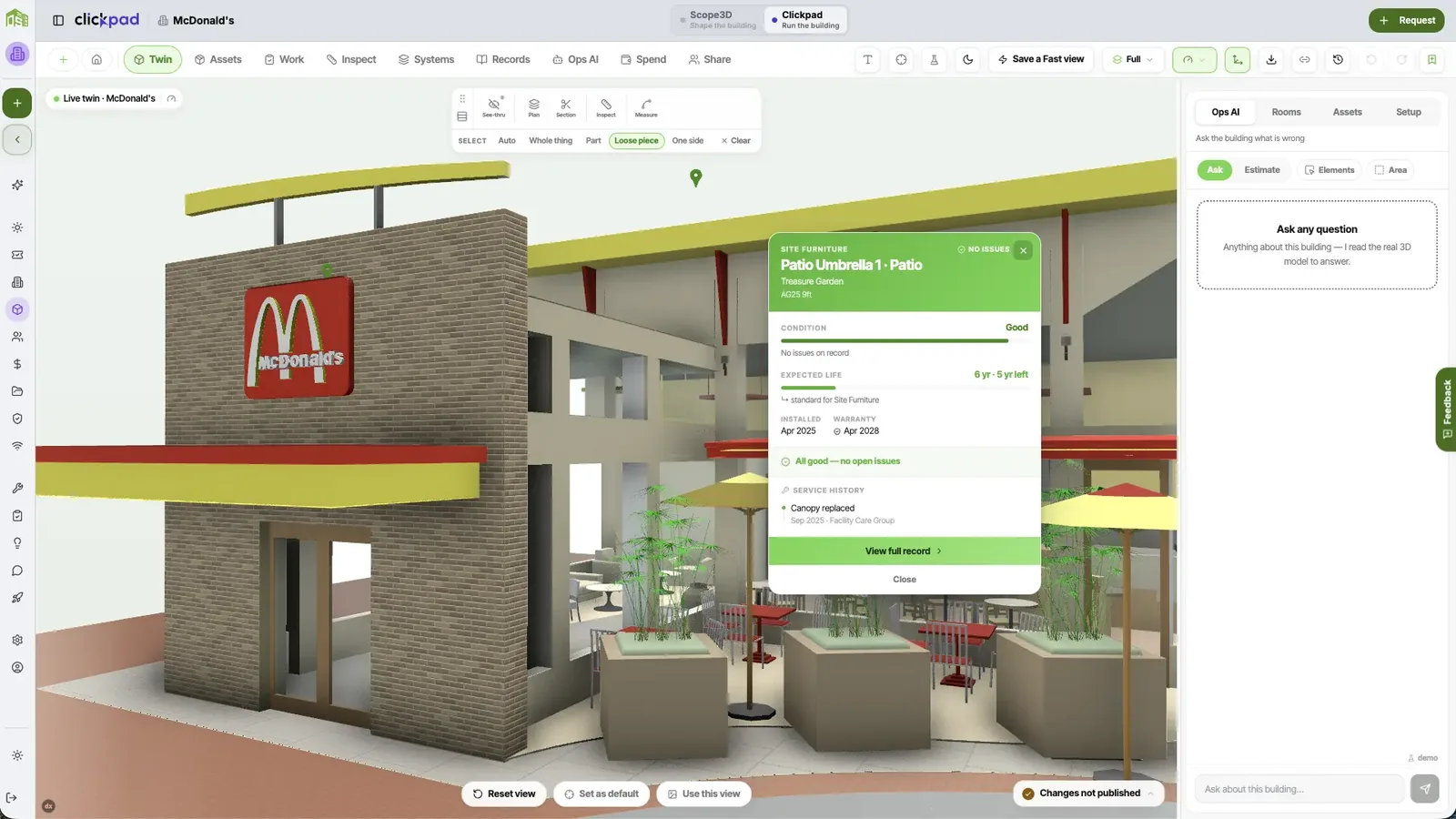
An asset page is not a specification sheet. The specs are on it, and under them sit the service logs and a history timeline: what was done, when, and against which job it was raised. One of the patio umbrellas on the outdoor seating reads as a sequence rather than a status — a Treasure Garden AG25 that went in last April, its canopy replaced in September by Facility Care Group, warranty running to 2028. When staff report that its crank has got stiff enough to take two people, the report lands against that history instead of arriving on its own.
Every asset also carries a section for what we do not know about it. A missing serial, no install date, no manual on file, a service interval nobody has confirmed. The gap is written down as a gap rather than left as an assumption, so the register is honest about its own coverage and the holes can be closed on the next visit rather than rediscovered on the next fault.
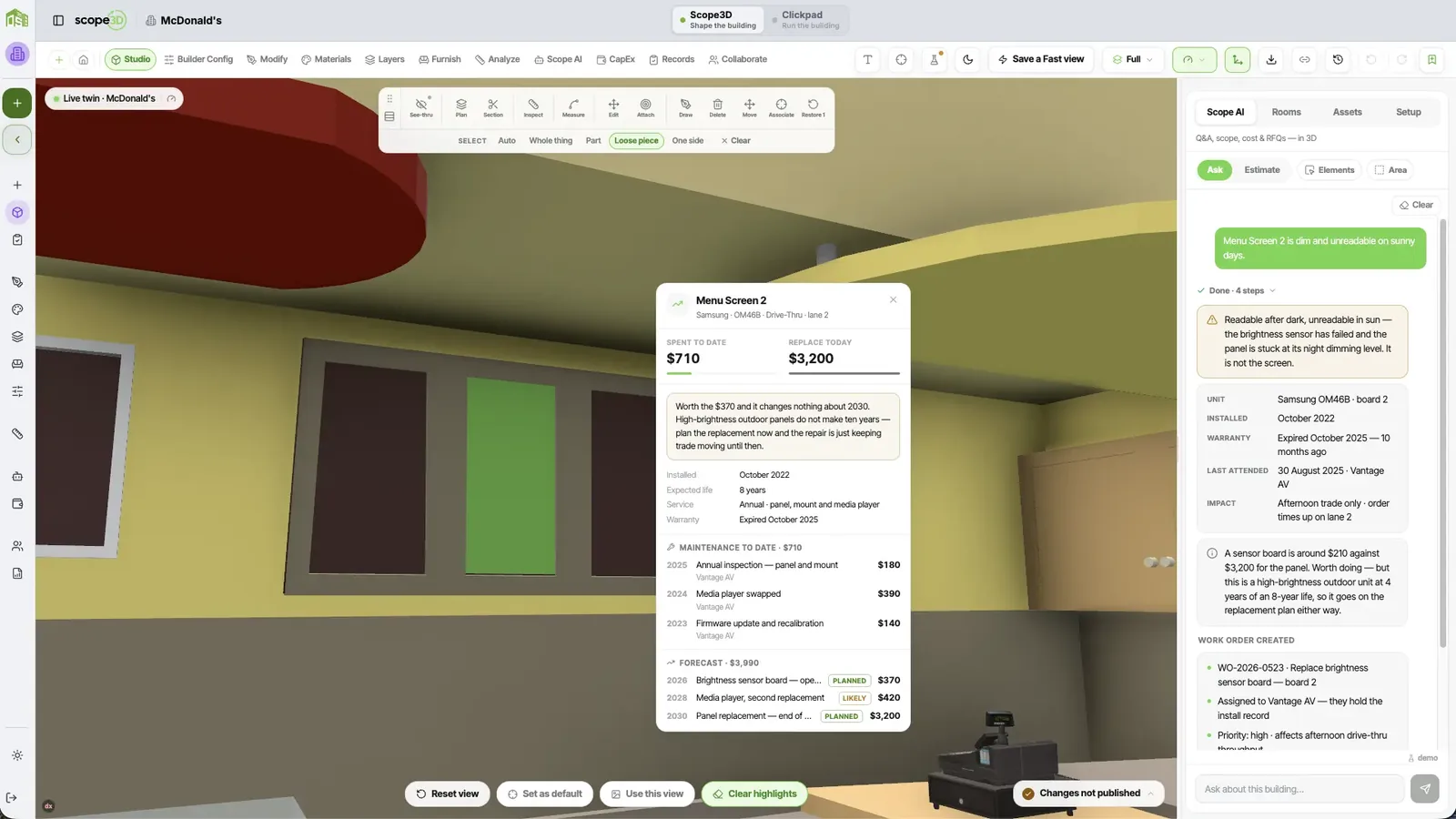
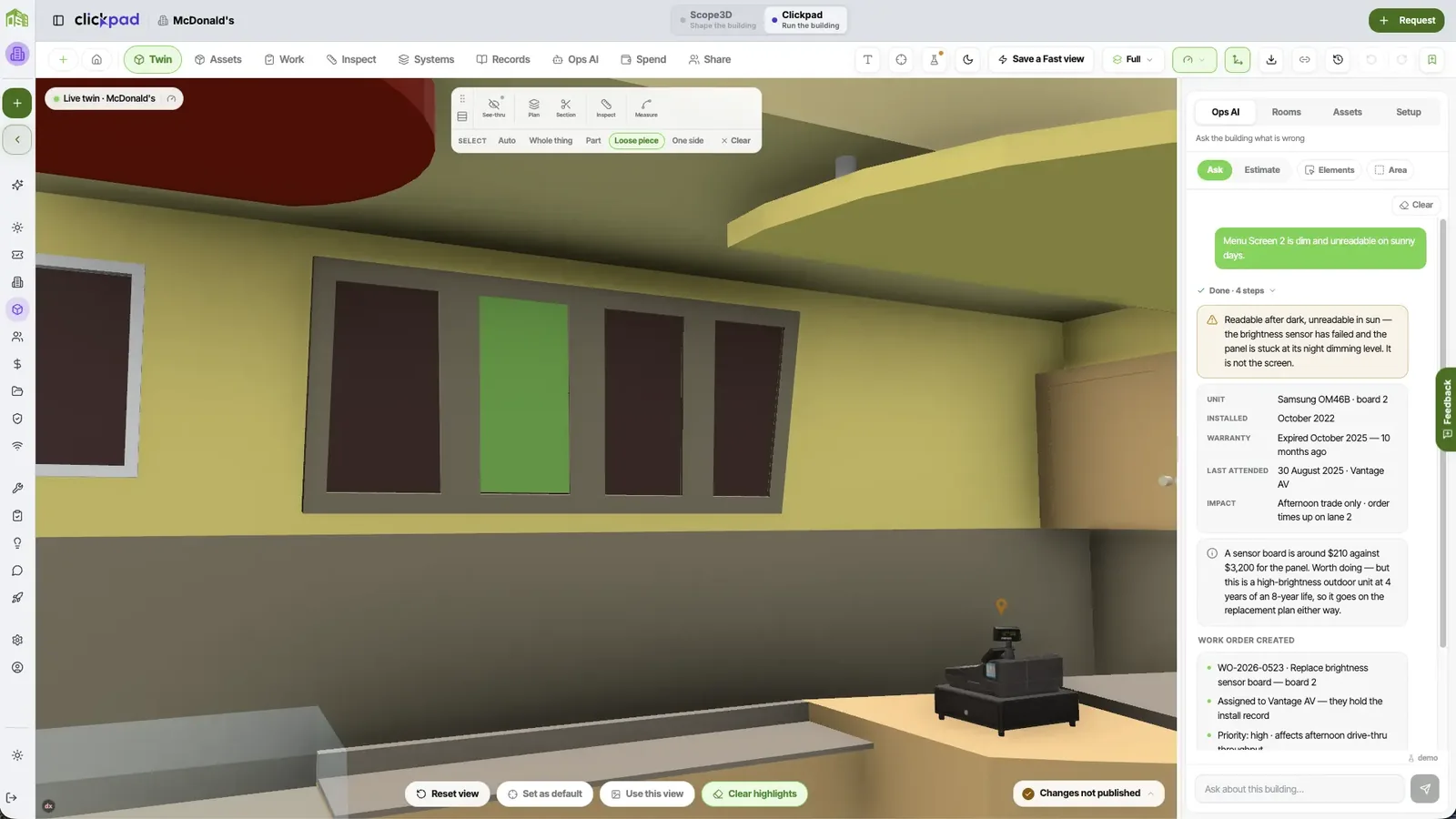
The copilot is per property. Asked why menu screen 2 is dim and unreadable on sunny days, it answers out of this site’s register rather than in general: a Samsung OM46B that went in in October 2022, last attended by Vantage AV, its warranty expired ten months ago. It reads the symptom rather than repeating it back — readable after dark, unreadable in sun, so the brightness sensor has failed and the panel is stuck at its night dimming level. It is not the screen. Then it prices both paths, around $210 for a sensor board against $3,200 for the panel, and notes that at four years into an eight-year life the unit joins the replacement plan either way. The work order comes out of the same answer, assigned to the company that holds the install record.
Maintenance runs off the same entries. Intervals live on the asset, so an asset that has gone past its own interval is visible as itself and not as a line in a schedule kept somewhere else. CapEx planning is a separate hub reading the same register — the assets, their ages, their histories, the warranties still in force and the work already done to them — so the years ahead are planned against what is recorded rather than against what is remembered.