
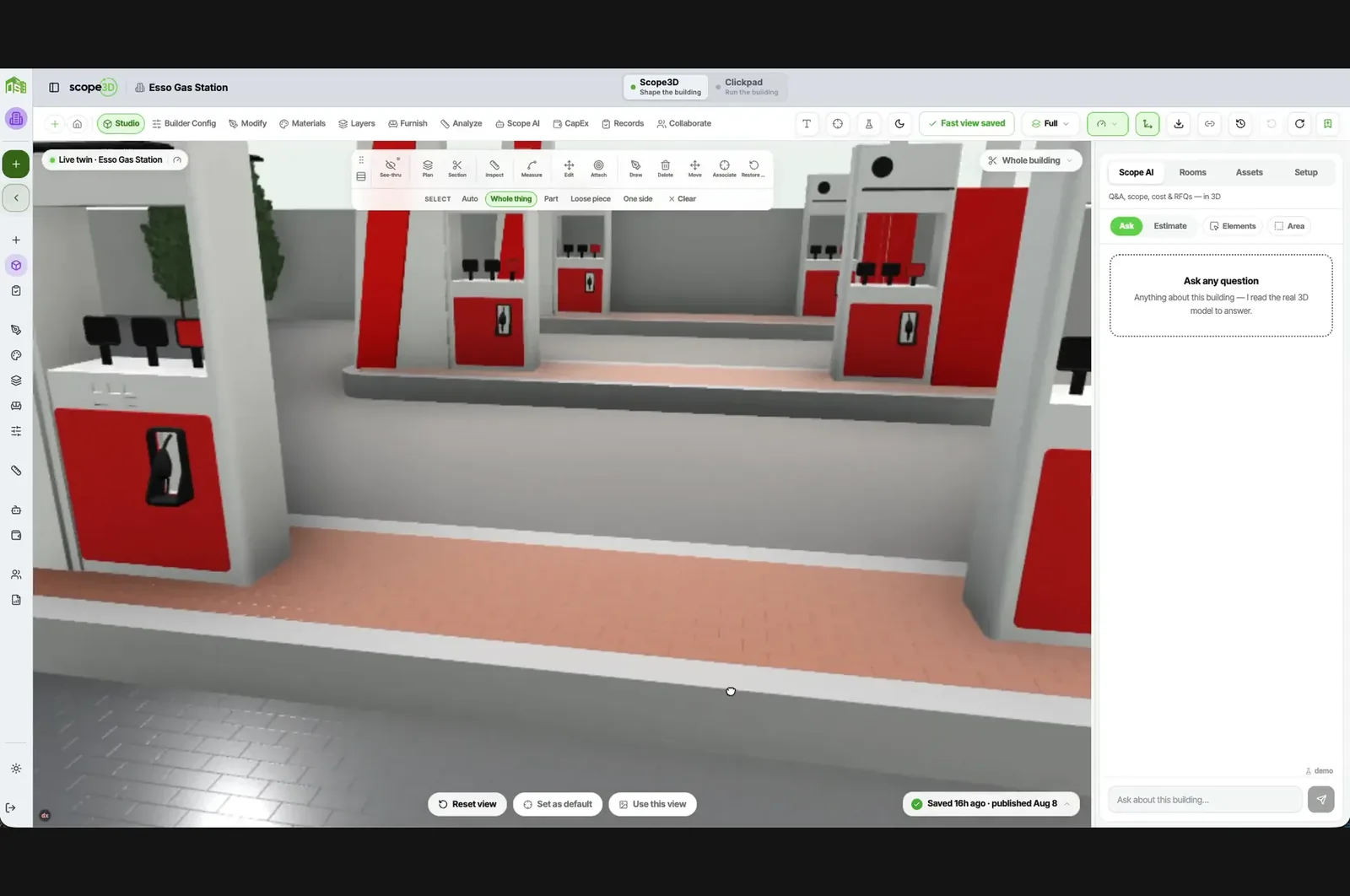
A building is not one model. It is an architectural model, a structural model, a plumbing model and a mechanical model, usually produced by different firms on different schedules and reconciled properly only when something clashes badly enough on site to stop work.
Merging them onto one twin makes that reconciliation visible before it becomes expensive. Each discipline arrives as its own IFC and stays its own switchable layer, so the combined building is real and complete without any of the constituent models losing its identity inside it.
The genuinely useful move is the negative one. Switch the finishes off and you reach the pipe, the duct and the cable running behind them — which is precisely what you need to know before anybody cuts into a wall on a live property with tenants in it.
That answers a question which is otherwise answered by opening the wall and finding out. What runs through this bulkhead? Which chase carries the return? A drawing set can tell you in principle, if you have all of it and can read all of it. A layered twin tells you in place, in about four seconds.
It also turns coordination into a conversation rather than an argument. Two disciplines occupying the same space is something everyone can point at together, with both models on screen, neither one redrawn or simplified to make the point, and no one relying on a screenshot taken last month.
Isolation works the same way for scope and for pricing. Turning everything off except mechanical gives you the mechanical building, and a takeoff from that state counts only what the mechanical contractor is actually being asked to price — which removes an entire category of scope dispute before anybody has quoted a number.
For operators the value lands later, long after the coordination meetings have been forgotten. The twin still holds the layers years after handover, so the person diagnosing a fault at eleven at night is reading the building rather than reconstructing it from memory and a folder of PDFs.
Nothing is flattened on the way in, which is what makes any of this reversible. Each model keeps its own elements and its own properties, so any single discipline can still be exported back out on its own and handed to the consultant who owns it.
The layering also makes gaps obvious. A twin with architecture and structure but no services is a twin that will answer half the questions asked of it, and it is much better to discover that while assembling it than during a refit.
The practical rule is therefore simple: bring every discipline you have, even the ones that look incomplete. A partial services model still tells you more than no services model, and it can be replaced later without disturbing the layers around it.
What you end up with is one building that can be interrogated from any trade's point of view — which is closer to how a building actually behaves than any single discipline's drawing has ever been.